
What Is the Ansoff Matrix?
The Ansoff Matrix is a strategic planning tool that helps businesses identify the best growth direction by evaluating whether to focus on:
1. Existing products vs New products
2. Existing markets vs New markets
It creates four clear growth strategies:
Market Penetration, Market Development, Product Development, Diversification
Why the Ansoff Matrix Matters
- Helps leaders choose the safest vs boldest growth moves
- Clarifies which opportunities align with capability & risk appetite
- Avoids random, unstructured expansion
- Useful for product strategy, GTM, and corporate growth planning
- Common in consulting, MBA prep, and case interviews
It’s one of the simplest and most intuitive growth frameworks.
The Ansoff Matrix (Core Structure)
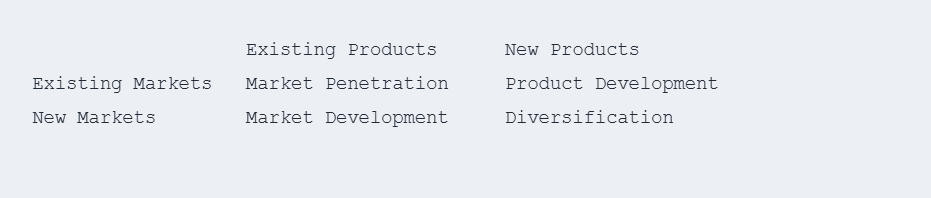
1. Market Penetration (Existing Product × Existing Market)
Safest growth strategy.
How to grow:
- Increase usage frequency
- Reduce churn
- Improve customer experience
- Gain share from competitors
- Launch targeted promotions
- Strengthen distribution
- Improve product quality
When to use:
- Market has room to grow
- Competition is weak or fragmented
- Company is already strong in the segment
2. Product Development (New Product × Existing Market)
Introduce new products to current customers.
How to grow:
- Add new variants
- Introduce premium or budget versions
- Launch complementary products
- Bundle services
- Add features or upgrades
When to use:
- Customer needs are evolving
- Strong brand loyalty
- Market saturated for existing products
3. Market Development (Existing Product × New Market)
Take current products into new geographies or segments.
How to grow:
- Expand to new cities or countries
- Target new customer groups
- Enter new distribution channels
- Adapt product for local preferences
When to use:
- Product is successful in existing market
- Similar customer behavior exists elsewhere
- Company has excess capacity
4. Diversification (New Product × New Market)
Highest risk, highest reward.
Types of diversification:
- Related diversification: enters adjacent category
- Unrelated diversification: enters completely new industries
How to grow:
- Build or acquire new capabilities
- Create entirely new product lines
- Acquire companies in new sectors
When to use:
- Market saturated
- Strong cash reserves
- Strategic long-term vision
- Need to reduce dependence on one business
How to Apply the Ansoff Matrix (Step-by-Step)
1. Assess current product-market position
Know where your strongest foothold is.
2. Identify growth goals
Revenue growth? Diversification? Market share?
3. Evaluate each Ansoff quadrant based on feasibility
Use data + capability assessment.
4. Choose the best-fit quadrant(s)
Most companies use a mix:
- 1 short-term bet (low risk)
- 1 long-term bet (higher risk)
5. Build an execution plan
- Investment
- Timeline
- Capability gaps
- Dependencies
- Partnerships
Mini Example: Ansoff Matrix Case
Company: A healthy snack brand selling granola bars
Objective: Grow revenue 30% next year
Market Penetration:
- Increase shelf space in supermarkets
- Boost ad spend
→ Expected growth: +8%
Product Development:
- Launch high-protein bars
→ Expected growth: +12%
Market Development:
- Expand to Tier-2 cities
→ Expected growth: +7%
Diversification:
- Launch healthy ready-to-drink smoothies
→ High risk, long-term option
Recommendation:
Focus on product development + market penetration for near-term growth.
Explore diversification via pilot testing.
Common Mistakes to Avoid
- Over-focusing on diversification (too risky)
- Ignoring capability constraints
- Launching new products without customer research
- Entering new markets without localization
- Trying to do all four strategies at once
Ansoff helps prioritize — not expand blindly.
Where the Ansoff Matrix Is Used
- Growth strategy
- Product strategy
- Market expansion
- Startup scaling
- Corporate planning
- Case interviews
It’s a simple but powerful roadmap for structured growth decisions.