
Overview
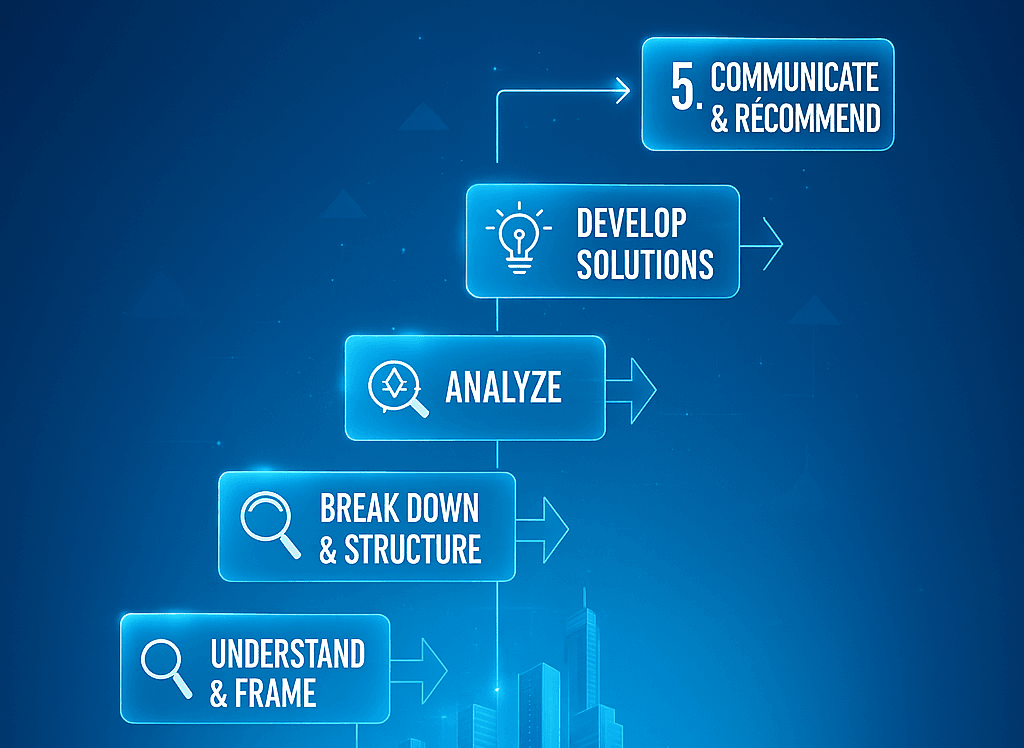
Case interviews look intimidating from the outside but once you understand how to approach a case, they become predictable, logical, and surprisingly enjoyable. Every consulting firm evaluates the same thing: your ability to break down a problem and think like a consultant.
This guide walks you through the exact step-by-step method used in real interviews.
1. Listen Carefully & Clarify the Core Problem
The first step is understanding exactly what the interviewer is asking.
Your goal is to clarify:
- the business objective
- the definition of success
- the scope of the problem
- any constraints
- the timeline or geography
For example, if the prompt is:
“Profits at a beverage company are falling. What would you do?”
Clarify:
- Are profits falling overall or in a specific segment?
- Are we analysing short-term or long-term issues?
- Are we focusing on one market or global operations?
A good clarifying question signals structured thinking from the very beginning.
2. Break the Problem Into a Clear, Structured Approach (Your Framework)
Next, outline the structure you will use to solve the problem: your framework.
This is the moment you bring in the frameworks.
Example for a profitability case:
“To understand the profit decline, I’ll break it down into revenue and cost. On the revenue side, I’ll look at price and volume. On the cost side, I’ll examine fixed and variable costs.”
Your framework should be:
- logical
- MECE
- tailored to the problem
- simple and clean
👉 Read detailed frameworks → Frameworks
3. Form Initial Hypotheses (What Might Be Going On?)
Hypotheses are not guesses, they are logical possibilities based on your structure.
Example:
“If the company hasn’t changed pricing, the likely issue may be declining volumes.”
Hypotheses guide your analysis and show you can think ahead.
4. Dive Into the Analysis (Charts, Data, Numbers)
The interviewer will give you:
- charts
- tables
- graphs
- short paragraphs
- market data
Your job is to:
- interpret the data
- find patterns
- identify drivers
- match insights to your structure
Good analysis looks like:
- “Sales volume fell 12% in Tier-1 cities.”
- “Competitor penetration increased sharply.”
- “Variable costs rose due to raw material inflation.”
No fluff, pure logic.
5. Run the Math Confidently (Even Simple Math Counts)
Case interviews require quick, clean math.
Not complex formulas, just structured reasoning.
Examples:
- growth rates
- percentage changes
- break-even
- market sizing
- unit economics
Good math shows:
- clarity
- composure
- attention to detail
👉 Practice guesstimates → Guesstimates
6. Prioritize What Matters Most
Consultants don’t explore everything, they focus on what moves the needle.
Ask yourself:
- “Which part of my framework has the biggest impact?”
- “Which insight explains most of the problem?”
- “Where should we dig deeper?”
Prioritization is a key skill interviewers evaluate.
7. Synthesize Your Findings
As you analyse each piece, keep summarizing:
- what you’ve found
- what it means
- what you want to check next
This shows you think in a structured, top-down manner.
Example:
“Based on the data, the primary issue seems to be declining repeat customers due to long delivery times. I’d like to explore what’s causing that delay.”
8. Deliver a Clear, Crisp Recommendation
This is the most important part: the final answer.
A great recommendation is:
- direct
- structured
- supported with evidence
- practical
Use the standard consulting format:
Recommendation → Rationale → Risks → Next Steps
Example:
Recommendation:
The company should improve kitchen capacity and streamline fulfillment to reduce delivery times.
Rationale:
Repeat customers dropped by 15%, mainly due to long wait times. Fixing fulfillment addresses the root cause of declining revenue.
Risks:
Cost of operational upgrades; potential implementation delays.
Next Steps:
- Run a 2-week pilot in high-volume zones
- Reconfigure shift scheduling
- Introduce a fast-service menu
This is exactly how consultants present solutions.
A Quick Case Example (Short Walkthrough)
Prompt:
A ride-sharing app is seeing declining weekly trips. What would you do?
Approach:
- Clarify → Only returning users declining
- Framework → Customer Journey + Pricing + Competition
- Hypothesis → Long wait times or rising fares
- Data → Shows competitor discounts + increased cancellations
- Conclusion → Retention issue driven by affordability + reliability
- Recommendation →
- offer retention discounts
- improve driver allocation algorithm
- reduce surge pricing windows
Simple. Logical. Structured.
Common Mistakes to Avoid
❌ Jumping into analysis without a structure
✔ Always outline your framework first
❌ Giving random solutions
✔ Use data and logic
❌ Overcomplicating
✔ Keep frameworks simple and MECE
❌ Weak recommendations
✔ Use the “Rec → Why → Risk → Next Steps” format
Final Thoughts
Approaching a case the right way isn’t about memorizing frameworks, it’s about developing a structured, business-first mindset. Once you master this method, case interviews become predictable and far less intimidating. Before you start practicing full business cases (Case Library), there’s one more essential skill every consultant must build: the ability to estimate logically. Guesstimates appear in almost every case interview and test your structure, assumptions, and number sense.
Next, we’ll break down what guesstimates are and how consultants solve them using simple, structured logic.
👉 Read Next: What Are Guesstimates? The Consultant’s Art of Structured Estimation