
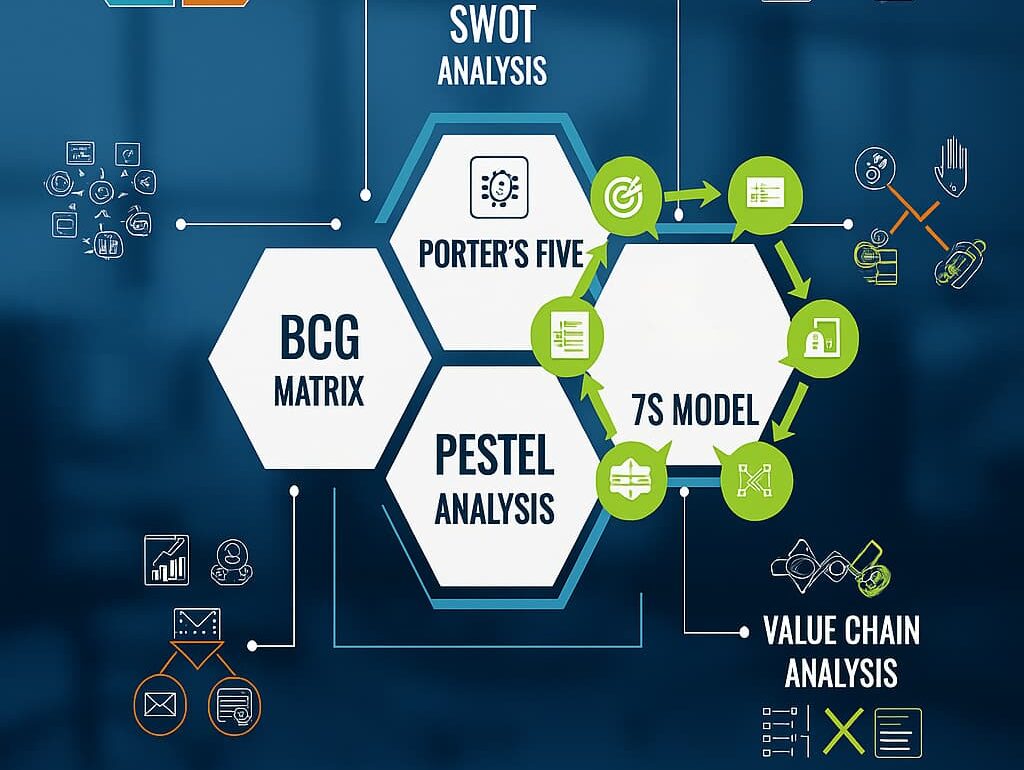
Overview
If you’ve ever tried to break down a business problem and didn’t know where to start, frameworks are the tools that bring instant structure. Consultants use them to simplify complexity, identify what matters, and analyze problems through proven lenses, whether it’s profitability, market entry, competition, pricing, or growth. Frameworks don’t give you the answer, but they give you a clear way to think about the problem. Once you understand how to use them, business challenges become far less intimidating and far more structured. Now, we’ll explore what frameworks are, why consultants rely on them, and how they help you solve problems more logically and confidently.
What Exactly is a Framework?
A framework is a structured way of approaching a business problem by breaking it into clear, logical parts. Think of it as a thinking blueprint: it guides your approach, ensures you cover everything important, and helps you communicate your reasoning clearly.
Frameworks also help you think in a MECE manner (Mutually Exclusive, Collectively Exhaustive), meaning your structure is clean, non-overlapping, and complete.
Read the full MECE guide → MECE: The Foundation of Structured Thinking
Why Frameworks Matter So Much in Consulting?
Case interviews, guesstimates, and real consulting projects all test the same thing:
Can you structure a vague problem into something solvable?
Frameworks help you:
- bring clarity to messy problems
- avoid missing important areas
- prioritize where to dig deeper
- speak logically under pressure
- move from problem → root cause → recommendation
An Important Note Before You Go Further
Frameworks are not checklists to memorize or templates to blindly apply.
Consultants rarely use any framework exactly as taught. Instead, they adapt parts of frameworks to fit the specific problem they are solving.
Think of frameworks as starting points for structured thinking, not final answers.
The Most Useful Consulting Frameworks
Below are the core frameworks you’ll use in case interviews and early projects.
Each one has a full, detailed explanation in the Frameworks Hub.
1. Profitability Framework
Used when a company faces declining profits.
Breaks down into:
- Revenue → Price × Quantity
- Costs → Fixed + Variable
This is the single most commonly tested case type.
▶ Read full guide: Profitability Framework: Cost & Revenue driver breakdown
2. Market Entry Framework
Used when a company wants to enter a new market, geography, or product category.
Includes:
- Market attractiveness
- Customer needs
- Competitive landscape
- Company capabilities
- Risks & financial viability
▶ Read full guide: Market Entry Framework: Assessing new market opportunities
3. 4Ps / 7Ps Framework (Marketing Mix)
Used for product, brand, pricing, and marketing problems.
- Product
- Price
- Place
- Promotion
(+ People, Process, Physical Evidence for services)
▶ Read full guide: 4Ps Framework (Product, Price, Place, Promotion): Marketing/strategy angle
4. Porter’s Five Forces
Used to evaluate an industry’s attractiveness or competitive pressure.
- Threat of new entrants
- Threat of substitutes
- Bargaining power of buyers
- Bargaining power of suppliers
- Competitive rivalry
▶ Read full guide: Porter’s Five Forces: Industry-level competitive intensity assessment
5. Customer Journey Framework
Used when analyzing customer experience or diagnosing funnel drop-offs.
Covers:
Awareness → Consideration → Purchase → Onboarding → Usage → Retention → Advocacy
▶ Read full guide: Customer Journey/ Experience Mapping: For service design cases
6. SWOT Framework
A quick, simple situational analysis tool:
- Strengths
- Weaknesses
- Opportunities
- Threats
Perfect for early diagnosis.
▶ Read full guide: SWOT Analysis: Foundational situational assessment
7. Value Chain Analysis
Used to understand where value is created or lost in operations.
Breaks down activities like:
- procurement
- production
- distribution
- marketing
- service
▶ Read full guide: Value Chain Analysis: Identifying where value is created or lost
In addition to these commonly used frameworks, there are additional ones to explore.
▶ Explore the complete Frameworks Hub → Frameworks
How to Choose the Right Framework?
Beginners often ask:
“How do I know which framework to use?”
Here’s the simplest approach:
- Profitability issue → Profitability Framework
- New market launch → Market Entry
- Marketing / brand / product issue → 4Ps
- Industry evaluation → Porter’s Five Forces
- Customer churn / drop-offs → Journey Framework
- Limited data → SWOT
- Operational inefficiency → Value Chain
And if none fits perfectly: adapt the framework.
Consultants rarely use anything straight from a textbook.
A Simple Example: How Frameworks Make Problem-Solving Easy
Problem: A café’s revenue has dropped.
- Profitability Framework
Revenue dropped → Quantity declining. - Customer Journey
Retention stage weak due to long wait times. - Value Chain
Kitchen is the bottleneck during peak hours. - Recommendation
- Streamline prep
- Add a fast-service menu
- Improve queue flow
- Upsell combos to regain volume
With frameworks, the problem becomes unbelievably clear.
Common Mistakes When Using Frameworks
❌ Memorizing frameworks without understanding
✔ Focus on the logic behind them
❌ Using the wrong framework for the problem
✔ Match the framework to the case type
❌ Using too many frameworks
✔ Stick to one primary, one supporting
❌ Presenting the framework instead of the insight
✔ Your recommendation matters most
Final Thoughts
Frameworks give you the structure to break down problems but structure alone isn’t enough. The next step is learning how to apply that structure on real business problems. That’s where case studies come in. They teach you how consultants think, analyse, prioritise, and recommend solutions.
Next, we’ll explore how case studies work and why they’re the most important part of consulting preparation → Case Studies: How Aspiring Consultants Learn to Think Like Pros